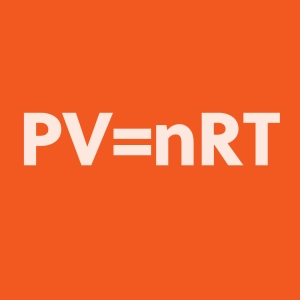
 pV = NkT
Learning objectives
- To describe the relationship between particle-wall collisions and pressure.
- To determine how changing a variable among P, V, N, and T influences the gas properties.
- To introduce some concepts about Kinetic Molecular Theory.
- To build conceptual understanding of molecular behavior.
- To reinforce the fundamental role of Avogadro's constant.
Building Conceptual Understanding of Molecular Behavior.
Beyond verifying mathematical proportionalities, the simulation offers a powerful window into the microscopic world that underlies macroscopic gas behavior. For instance, you can increase the number of molecules (N) or mols (n) while keeping volume and temperature fixed, and directly observe how a greater number of particles produces more frequent wall collisions, thus raising pressure.
This makes the molecular interpretation of pressure deeply intuitive. Teachers can also guide students to connect the kinetic energy of molecules to temperature, helping them understand that temperature is not just a number on a thermometer but a measure of molecular agitation. By playing with all parameters, students can build a bridge between the particle model and the ideal gas equation PV = nRT. This multi-scale perspective — from individual molecules to measurable quantities — is essential for developing lasting conceptual understanding.

Discover EduMedia for free
The interactive encyclopedia that brings science and math to life in the classroom.
O v e r 1 , 0 0 0 r e s o u r c e s